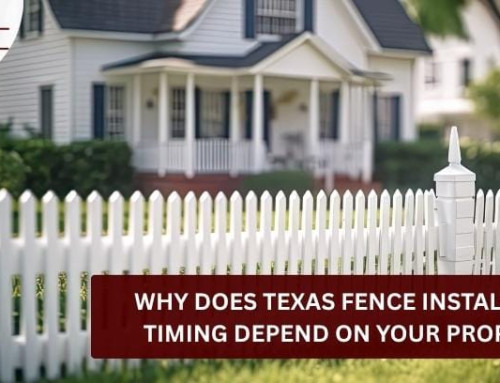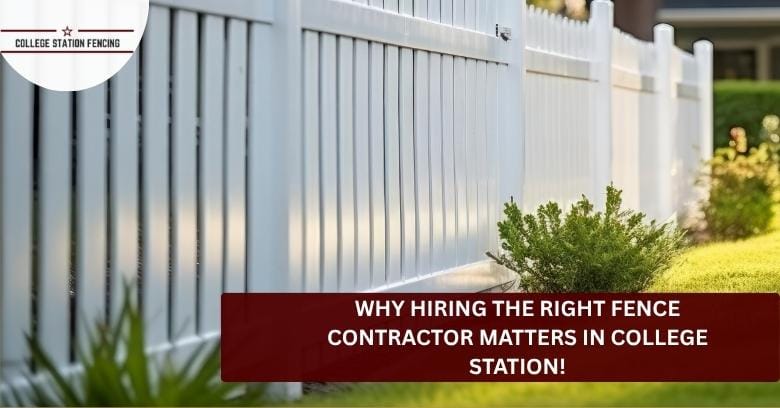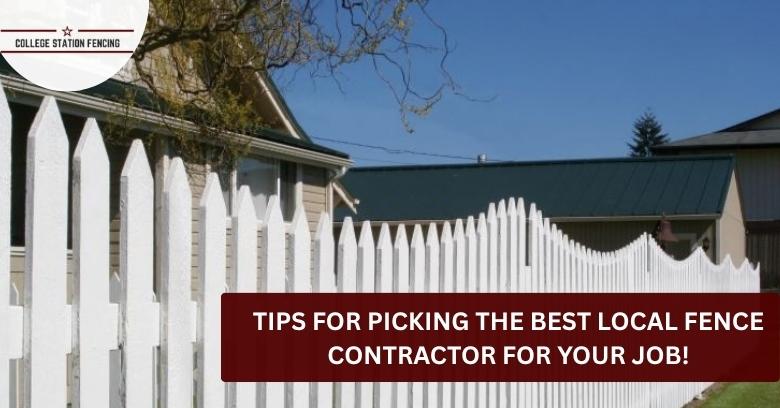
Most homeowners think about their fencing& after a dog digs it out, a storm knocks out a section, or a neighbor's new build suddenly looks into the back patio. By then, they decide quickly, usually choosing whatever material is cheapest that week. The result is a fence that does its job for a few seasons and then leans, greys, and quietly drags down the look of an otherwise well-kept house. A fence is the longest continuous line on most residential lots, and it frames everything behind it. Done well, it reads as part of the architecture. Done poorly, it reads as a repair waiting to happen.
That matters more here than in many markets. Homes in College Station, Texas, and nearby Bryan sit on expansive clay that swells and shrinks with every wet-dry cycle, bakes under 95 to 105-degree summers, and takes a beating from spring straight-line winds and hail. Style choices that hold up in a mild climate fail within a few years if the posts, rails, and hardware underneath are wrong. An experienced fence contractor plans the structure first and the look second, because the look only lasts as long as the structure.
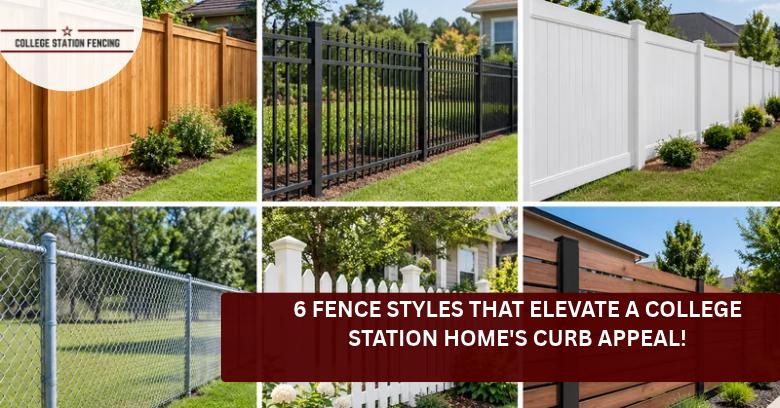
This article walks through six fence styles that genuinely improve curb appeal on local lots that includes: board-on-board, shadowbox, horizontal cedar, cedar-and-iron combination, ornamental aluminum or iron, and tubular steel ranch rail. It also covers the soil, code, and HOA realities that shape which of those styles will work on a given property, along with cost ranges, timelines, and the maintenance schedule that keeps a new fence looking new.
Before Style: What Clay, Code, and the HOA Decide
Soil Movement and Post Choice
The uplands across Brazos County are heavy Houston Black and Zulch-type clay. It expands when wet and pulls away when dry, and that cycle is the single most common reason a three-year-old fence leans. Treated pine 4x4 posts rot at grade and twist with the soil. The dominant local build answers that with galvanized steel posts, typically 2 3/8-inch outside diameter or 16-gauge, carrying cedar rails and pickets. Holes usually run 24 to 36 inches deep and 10 to 12 inches across, with one to two bags of concrete each; posts are set on 8-foot centers and tightened to 6 feet near gates or wind-exposed runs.
Bottomland closer to the Brazos and Navasota rivers is sandier and drains faster, so a fence contractor may spec depth differently there than on a Greens Prairie or Rock Prairie Road lot in College Station. That is also why August augering sometimes needs pre-soaking and why a wet spring stalls digging and concrete pours. Properties from Navasota, Texas, to Hearne, Texas, can sit on noticeably different ground within a short drive.
HOA Rules, City Limits, and Setbacks
Fencing style freedom is narrower than most buyers expect. Neighborhoods such as Castlegate II, Pebble Creek, Williams Creek, Edelweiss, and Greens Prairie Reserve commonly dictate height, picket orientation, stain color, and “good side out.” Architectural committee review usually comes first and often takes 1 to 4 weeks. The City of College Station generally allows lower fences in front yards than in rear and side yards, commonly around 4 feet front versus 6 to 8 feet rear, and restricts sight-triangle obstruction at corner lots. Requirements change, so confirm current rules with the City before ordering material.
Two other steps belong in every plan: a Texas811 locate request two business days before digging, and setting the fence 6 to 12 inches inside the property line based on survey pins or the recorded plat. Fence contractors see more disputes from guessed property lines than from any other cause.
Six Fence Styles That Lift Curb Appeal
1. Board-on-Board With Cap and Trim
Board-on-board overlaps each picket by roughly an inch, so no gaps open as cedar dries and shrinks. Add a top cap and trim board, and the fence gains a finished edge line that reads like cabinetry from the street. Homeowners most often choose this style when they want the fence to match a brick-and-stone elevation instead of disappearing behind it. Ask the fence contractor to include a 2x12 treated rot board at grade and three 2x4 rails on a 6-foot run, because cap-and-trim detailing is wasted if the bottom edge wicks moisture and fails early.
2. Shadowbox
Shadowbox alternates pickets on opposite sides of the rails, creating a woven look that appears finished from both faces. That solves the “which side faces my neighbor” argument on shared lines, and it breathes, which helps on exposed runs where spring winds hit hard. Privacy is good straight on and partial from the side, so fence contractors suggest it more for interior lots than for fences fronting a busy street. It is a frequent pick on older blocks around Bryan, Texas, where neighbors split the cost, and both want the attractive face.
3. Horizontal Cedar
Horizontal cedar is the style homeowners ask about most after seeing it online, and it does make a modern elevation look deliberate. It also demands more from the build including closer post spacing, stiffer framing, and straight, well-selected boards, since any cup or sag shows instantly on a horizontal line. A fence contractor should be candid that horizontal layouts cost more in labor and material waste. Many architectural committees restrict the style outright, so submit the design before scheduling anything.
4. Cedar-and-Iron Combination
Pairing cedar privacy panels with ornamental iron sections lets a yard stay private where it needs to be and open where a view is worth keeping. A common layout runs solid cedar along side lines and iron across the rear where the lot backs to a greenbelt, pond, or pasture. The transition posts carry a heavy load, so steel posts and hot-dip galvanized hardware matter here more than anywhere. This blend works well on acreage-adjacent properties near Wellborn and on larger lots outside Bryan, Texas.
5. Ornamental Aluminum or Iron
Ornamental metal is the clearest curb-appeal upgrade for front yards, courtyards, and pool enclosures. It meets front-yard height limits without blocking the house; it never needs stain, and it frames landscaping instead of hiding it. For pool barriers, Texas Health and Safety Code Chapter 757 and the related residential code appendix call for a minimum 48-inch height, gaps no wider than 4 inches, no footholds on the outside face, and a self-closing, self-latching gate with the latch 54 inches or more above grade or mounted inside. A fencing company should design to those requirements from the start, and the inspecting authority always makes the final determination.
6. Tubular Steel Ranch Rail
On larger parcels, tubular steel or pipe ranch rail does what no privacy fence can do. It defines the property without interrupting the view. It handles livestock pressure, shrugs off hail, and costs far less per linear foot than solid wood. Many owners combine it with wire mesh for dogs or with barbed wire on working acreage. It is the default along rural frontage between College Station, Texas, and the smaller towns to the north, and fence contractors often pair it with a masonry or cedar entry feature at the drive for presence.
Matching the Style to the Lot
Choosing well is mostly about honest answers to a few questions:
- Front yard inside a managed subdivision: ornamental aluminum or iron, kept at the lower front-yard height, with committee-approved color.
- Shared side line with an involved neighbor: shadowbox, or board-on-board with the good side out as most covenants require.
- Rear line facing a greenbelt or pond: cedar-and-iron combination so the view stays.
- Modern or recently remodeled elevation: horizontal cedar, if the covenants allow it.
- Acreage, livestock, or long road frontage: tubular steel ranch rail, with mesh added where pets are a factor.
- Pool enclosure of any kind: ornamental metal with self-closing hinges and a compliant latch height.
Student-rental turnover near Northgate, family neighborhoods off Rock Prairie Road, and Wellborn-area acreage create very different needs inside the same ZIP code, which is why a walk-through with a fence contractor beats a phone quote.
Budget, Timeline, and Upkeep
What Styles Typically Cost
Installed costs across the Texas market generally run from about $18 to $30 per linear foot for treated pine privacy, $28 to $55 for cedar privacy, $35 to $60 for board-on-board with cap and trim, $35 to $70 for ornamental iron or aluminum, $30 to $60 for vinyl, and $12 to $25 for pipe or ranch rail. These are broad trade ranges, not quotes. Automated gate operator packages commonly range from $2,500 to $7,500 installed, depending on swing versus slide, solar versus hardwired power, and extras such as keypads or loop detectors. A fence contractor can usually rough in conduit and a gate-rated post during the original build, so you can add keypad entry later without tearing anything out.
Staining and Maintenance Windows
New cedar should breathe 2 to 4 weeks before stain; new treated pine needs 3 to 6 months. Re-coat a semi-transparent oil finish every 2 to 3 years under Texas UV, and apply it between 50 and 90 degrees with 24 to 48 hours of dry weather, which in practice means spring and fall. Unsealed pickets cup and gray fast in July and August heat. Installing a typical 150 to 200-foot run takes 1 to 3 days, plus concrete cure time, and committee or permit review can add 1 to 4 weeks. Good fencing services will sequence approval, location, and installation so the crew doesn't wait on paperwork. Homeowners around Bryan, Texas, often schedule the work in late winter so the stain window lands before summer.
Final Thoughts
Curb appeal is not a style catalog decision. It comes from choosing a look that fits the house, then building it on steel posts set deep enough for clay that moves every season. Board-on-board, shadowbox, horizontal cedar, cedar-and-iron, ornamental metal, and ranch rail each suit a different lot, budget, and set of covenants. The right fence contractor will tell you which styles fit a given property and which ones will disappoint.
Homeowners in the College Station, Texas, area should start with the property line, covenants, and soil, then choose a style. A local fencing company that knows these neighborhoods will speed approvals and prevent the leaning-post call three years out. Start today: request a free estimate and schedule a walk-through before the next storm season!
Key Takeaways
- Galvanized steel posts set 24 to 36 inches deep handle Brazos County clay far better than treated pine posts at grade.
- Architectural committee approval and City height rules should be confirmed before any material is ordered, since review commonly takes one to four weeks.
- Board-on-board with cap and trim, shadowbox, horizontal cedar, cedar-and-iron, ornamental metal, and ranch rail each fit a different lot type.
- Pool enclosures must meet height, gap, foothold, and self-latching gate requirements under Texas code, and the inspecting authority makes the final call.
- Submit a Texas811 locate request two business days before digging, and set the fence 6 to 12 inches inside the surveyed property line.
Frequently Asked Questions
Which side of the fence should face my neighbor?
Most covenants require the finished side to face out toward the neighbor or the street. Shadowbox sidesteps the question entirely because it looks the same from both sides, which is why neighbors who split costs often choose it.
Why did my last fence lean in only three years?
Almost always because wood posts were set too shallow in clay that swells and shrinks. Steel posts in 24 to 36-inch holes with proper concrete volume resist that movement far longer.
Cedar or treated pine in this heat?
Cedar holds its shape better and resists checking and insects, while treated pine costs less up front. Either one needs a stain schedule, and pine must dry 3 to 6 months before the first coat.
Will my HOA approve horizontal slats?
Some do, and many don't, so submit the design to the architectural committee before buying materials. Approval often also governs height, picket orientation, and stain color.
Can I add a keypad gate later?
Yes, if the gate post and conduit are planned during the original installation. Operator packages generally run $2,500 to $7,500 installed depending on swing or slide, power source, and accessories.
Do I need a permit to replace a fence?
Requirements vary by location and project scope, so confirm with the City before work begins. Subdivision covenants often apply in addition to municipal rules.
How long does installation take?
A typical 150 to 200-foot run usually takes one to three days to install, plus concrete cure time. Handle approval and locate requests first, which can add one to four weeks.
Who owns a fence on the shared line?
That depends on where the fence sits relative to the surveyed line and on any written agreement between the two owners. Survey pins or the recorded plat settle it, not a neighbor's recollection.